
By Em Worthington
More than money
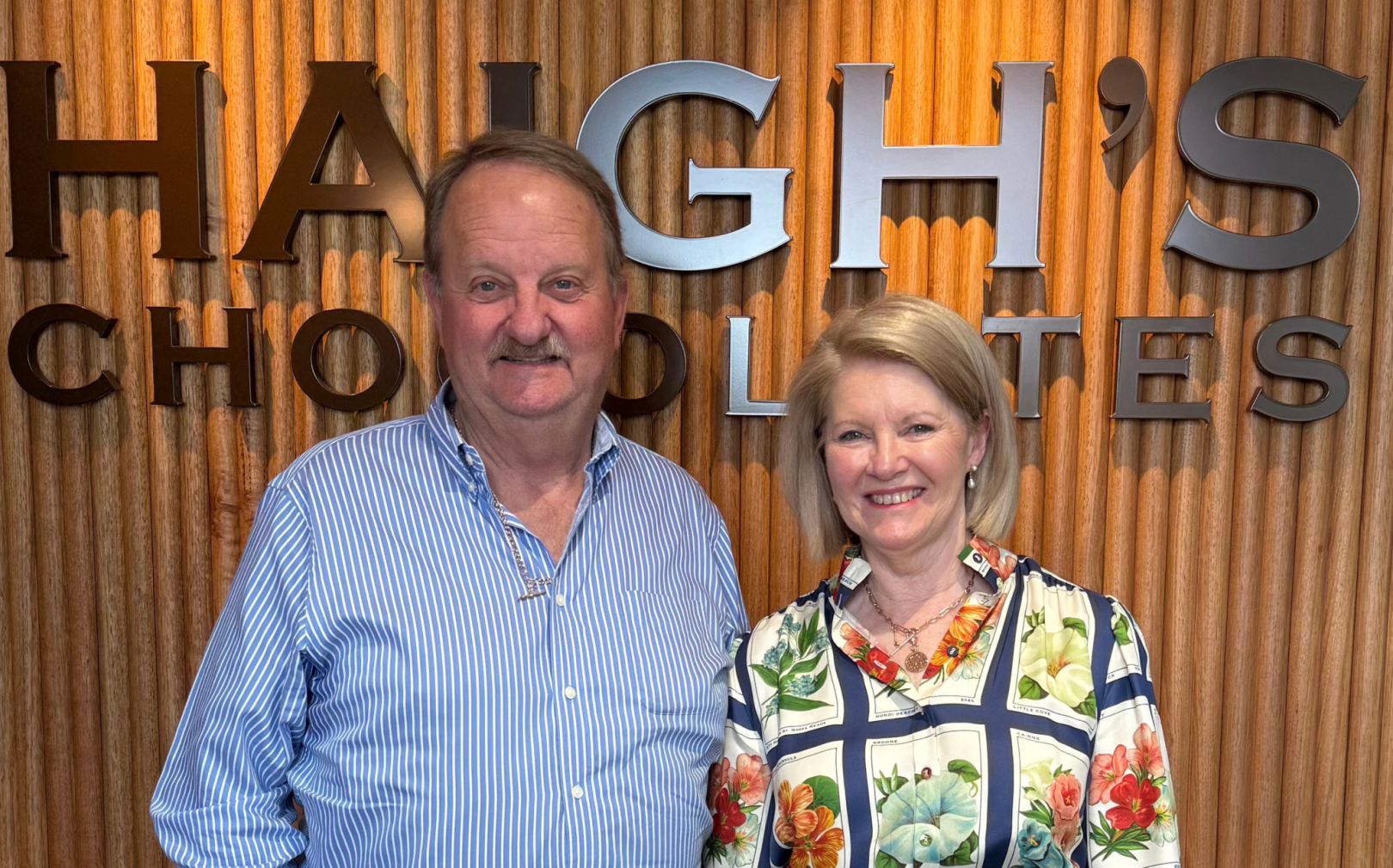
The Haigh name is synonymous with chocolate in South Australia, with the family business a familiar part of Adelaide life for more than a century. Alister grew up with giving as part of the Haigh’s tradition, while Sue’s own approach was shaped by country community life and a career in health. Together, those experiences have influenced how they give today, both personally and through the business.
“To me, giving means more than just money,” Sue says. “Giving of yourself, I think, is possibly even more powerful.”
It’s an idea that has followed Sue and her husband, Alister, throughout their lives, from country communities where everyone simply pitched in, to a family business that has long found its own ways to contribute.
Today, that might mean funding a project, donating Haigh’s chocolate to a community organisation or, for Sue, the decidedly unglamorous task of making up information packs or helping with administration.
“It’s mindless sort of stuff,” she laughs. “But when you’re at my stage of life, if I’m doing something useful that’s saving them the cost of somebody else doing it, somebody else can be doing something more useful.”
For Alister, years spent immersed in the family business meant time was often the thing in shortest supply. “I’ve been so busy with work,” he says. “For me, it’s been more about money than time.”
Where it began
Neither Alister nor Sue remembers philanthropy being discussed formally when they were young. Giving was simply part of community life.
Sue grew up in regional South Australia, where her father was heavily involved in Scouts. She joined Brownies and Guides, and local shows, community groups and fundraisers were part of life. She still remembers her father joining the children for a roughly 28-kilometre fundraising walk, despite not being particularly athletic.
“He came in after dark and then probably couldn’t walk,” she laughs. “But that was sort of what you did, I suppose.”
Alister spent much of his childhood at boarding school but encountered that same community spirit when he left school and spent six months jackarooing near Spalding.
“It doesn’t get done unless you help,” he says.
Giving was already part of the family business, too. Alister remembers his father giving his time, while Haigh’s was generous with chocolate. That continues today in all sorts of practical ways. A trial run for a new product, for example, might result in 20 or 30 kilograms that doesn’t quite match the final specification.
“We’re happy to supply that to Foodbank so they can add it to their distribution,” Alister says.
As Haigh’s has grown, its approach to giving has become more formal. In the earlier days, Alister personally fielded many of the requests for donations. Today, they are assessed against guidelines that consider the event, its location, other support being provided and whether the organisation has already received a donation that year.
Haigh’s has long been part of South Australian community life. Its city store became such a well-known Adelaide meeting place that “Meet at the Beehive Corner” was a familiar refrain for generations of South Australians.
“It was a community location, if you like,” Alister says.
With requests coming from all corners of the community, Haigh’s tries to spread its support around. “We try and limit it to once a year to any one organisation,” Alister says.
Giving with purpose
Alister and Sue have supported a wide range of organisations and projects over the years, including Variety SA, while Alister also served as the former Co-Chair of the Heysen Foundation Cedars project. Their longest continuous commitment has been as Founding Ambassadors of SAHMRI, and more recently, their support has extended to Guide Dogs, Lions Hearing Dogs and the new Cancer Council building in Adelaide.
“It’s often the people that get us involved to start with,” Alister says. “It’s the organisation and the projects that keep our interest down the track. If you stop supporting an organisation just because a particular person left, it makes it very difficult for the organisation.”
Sue’s background in health has naturally influenced the causes that catch her attention. She trained in general nursing and midwifery before moving into infant welfare and later health counselling.
“Empowering people to understand and make their own decisions, so that they are not always going to be reliant on people, I think is invaluable,” she says.
She is particularly passionate about preventative health and research, including studies into preventing premature birth and improving developmental outcomes, and more recent work examining the use of breast milk banks for premature babies.
“You’ve got to have evidence-based research,” Sue says. “Anecdotally, a lot of it is good enough for me, but that’s not good enough to get it out there. Everything has to be proved.”
That interest in what their support actually achieves continues long after they decide to give.
“We don’t sort of donate and forget,” Alister says. “We follow projects through.”
That might mean visiting a facility they have helped support, keeping in touch with the people involved or simply watching a project take shape.
Through their involvement with assistance-dog organisations, they have also learnt how the role of trained dogs has expanded. Sue was particularly struck to learn that some can recognise changes in a person’s health and alert them or others to danger.
“It’s nice to have a personal connection, or to actually know what they’re doing rather than, ‘Here you go,’ and throwing some dollars around,” she says.
Helping create opportunity
While Haigh’s receives requests from across the community, causes involving children and young people hold particular appeal. The business and family have supported initiatives aimed at improving education, opportunity and wellbeing, including programs working with Indigenous children to encourage school attendance.
“There are lots of kids that are at a disadvantage through no fault of their own,” Alister says. “If there’s anything we can do to help break the cycle…”
That same thinking extends to other causes the family has supported, from disability services to equipment that can help people live more independently. Sometimes their own children bring those needs to their attention. Their daughter works in an area connected with spinal injury, for example, and has approached them about funding equipment that an organisation might otherwise struggle to afford.
For Alister and Sue, seeing their children find causes that matter to them is particularly important.
“One of our biggest challenges is instilling into the next generation the benefits of philanthropy,” Alister says.
They also recognise that younger family members are at a different stage of life, juggling careers, mortgages and children. Rather than simply telling them that giving matters, Alister and Sue want them to experience it for themselves.
“You actually give them a budget, and then they’ve got to sit down as a group and work out how to spend it,” Alister says. “That seems to make a bit of sense.”
In many ways, it brings them back to where their own stories began, in communities where nobody necessarily called what they were doing “philanthropy”. They simply saw what needed doing and helped, in whatever way they could.
For the Haigh family, that spirit of giving has taken many forms over the years — money, time, chocolate or simply lending a hand. However they choose to give, it’s the collective impact that matters. Or, as Sue puts it: “It all adds up.”
Our heartfelt thanks to Alister and Sue Haigh for sharing their time and giving story with us. Stay tuned for more incredible South Australians in our ongoing series.
Want to get involved or have a question?
We’d love to hear from you. Get in touch with Kay Burton.